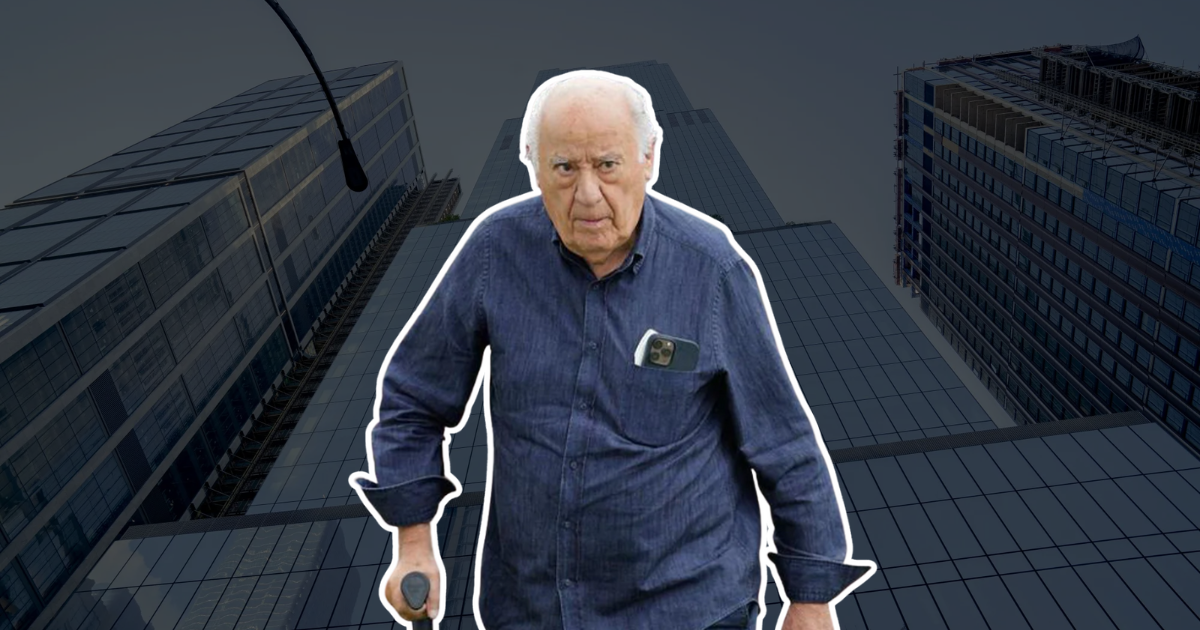
Editorial illustration. The composite above is not a verified photograph of 366 Madison Avenue.
The price comparison behind Amancio Ortega’s Manhattan office-sale story is real: New York City’s property portal lists a $115.5 million purchase deed in 2006 and a $50 million deed in 2025. That is a 56.7% nominal decline in the transaction amount, rounded to 57%. It does not measure the owner’s total investment return across the holding period.
Separate the original report from the later record
Larry Getlen’s September 5, 2025 Commercial Observer report described a Pontegadea unit, part of Zara founder Ortega’s family office, as being under contract to sell 366 Madison Avenue to Sioni Group for $50 million. Eastdil Secured served as the seller’s exclusive adviser. The article credited Bloomberg with the initial reporting and said the parties had not supplied comment.
The later NYC Department of Finance property-portal record, checked October 3, 2026, lists a deed dated October 21, 2025, from PONTE GADEA MADISON, LLC to 366 MAD LLC for $50 million, recorded October 23. It also lists the November 16, 2006 deed for $115.5 million. The portal identifies the property as Manhattan block 1281, lot 56, and lists 84,518 square feet and 15 stories. Its sales table is an informational record summary, not the full deed document.
Sioni Group’s current property page markets space at 366 Madison Avenue near Grand Central Terminal. That is useful first-party leasing context; an availability page does not disclose the former owner’s rents, expenses or investment return.
Calculate the price change, then identify what is missing
The arithmetic is $115.5 million minus $50 million = $65.5 million. Dividing $65.5 million by the $115.5 million purchase amount gives approximately 56.71%. This compares two nominal transaction amounts. It is neither an annualized return nor a calculation of profit after nearly two decades of ownership.
A total investment analysis needs the cash flows between acquisition and sale, with their dates and a stated basis. For an owner reviewing a similar asset, assemble:
- Acquisition spending: purchase amount, closing costs and the actual equity contributed.
- Operating cash flows: rent and other receipts, operating expenses, vacancy and concessions over the holding period.
- Additional investment: improvements, tenant buildouts, leasing commissions and other capital contributions.
- Exit cash flows: sale proceeds, transaction costs, financing payoff and applicable taxes, with financing treated consistently for the return measure selected.
An unlevered property return and an equity return answer different questions. Financing changes the owner’s cash contributions and receipts. An annualized calculation also depends on when those flows occurred. The two deed amounts alone do not establish any of those results.
Apply the lesson to the property you own
Review leasing viability alongside location
A well-known address is one part of an investment case. Review the actual rent roll, collections, lease expirations, tenant requirements and work needed to make vacant space usable. Then compare the property with relevant local transactions. This Manhattan price comparison does not establish the current value of a California office or mixed-use building.
Keep proposed improvements tied to a leasing purpose and a cost estimate. What space would become usable? Which tenant requirement would the work address? What rent, vacancy and completion assumptions support the proposal? Separate those assumptions from signed leases and cash already received.
Review financing with the lender’s actual terms
If a loan maturity or refinance is approaching, review the debt balance, maturity, current operating results, required work and the lender’s terms for that property. One celebrity transaction does not determine the lender’s valuation, loan offer or local tax assessment. Record the assumptions behind your own refinancing and hold-versus-sale comparisons.
Consider concentration and an executable exit
Diversification starts with an owner’s circumstances: how much capital and cash flow depend on one building, tenant, property type or market? Review that concentration before considering a purchase or sale. Adding a different asset is not automatically protection; its costs, risks and operating needs require their own analysis.
For an exit review, compare estimated net sale proceeds with a holding forecast that includes vacancy, capital work and financing needs. Keep the timing and assumptions visible. The useful decision is whether a proposed plan fits your property and resources, rather than whether another investor can absorb a reported price decline.
Bring the operating evidence into the investment review
Our commercial property ROI guide explains the operating numbers owners should review and keeps net operating income separate from investor return. Use it alongside the rent roll, operating statements, lease obligations and capital plan for your own property.
For broader management education, Property Management Excellence by Anthony A. Luna is an optional resource on management principles and owner mindset. The transaction sources above support this news story; the book is not evidence of Ortega’s investment result.






.webp?width=300&height=200&name=charles-forerunner-3fPXt37X6UQ-unsplash-1920w%20(1).webp)